Stop patching broken bones with band aids.

You've done the courses, watched the videos, tried the trainers. Some of it helped a little. None of it held. Because when there's something fundamentally misunderstood between you and your horse, surface fixes don't reach it.

A behaviour assessment isn't another thing to try. It's the thing you do when you're ready to actually find out what's going on — and build from there properly.

What we look at

A horse behaviour consultation isn’t a quick fix, it’s a deep dive into understanding the why behind the behaviour, so we can create a tailored plan that works for both you and your horse.

During a consultation, we’ll look at:

Your Horse’s History - We’ll consider vet history, past handling, and what you know about your horse’s life before they came to you — all of which can influence current behaviour.

Their Environment - Behaviour can change based on location. We’ll assess where the issues occur, at home, out, or in transit, and look for patterns or triggers.

Their Management - Feeding, turnout, herd dynamics, and daily routines all matter. Even small mismatches in management can create stress that shows up in behaviour.

Their Training - We’ll look at what your horse knows, where there may be gaps or confusion, and whether past handling or training is still affecting them.

The Problem Behaviour - We’ll explore the specific behaviour you’re seeing, like bucking, bolting, or biting, and uncover what your horse might be trying to communicate.

A person wearing a black helmet and jacket holding a brown horse by its bridle, standing on a muddy ground with green plants and a wooden fence in the background.

How does it work?

To book: contact me to arrange a consultation

Before: You'll complete a detailed questionnaire about your horse’s history, management, and behaviour concerns.
Please return it at least 2 days before your scheduled session so I can review it in detail.

so I arrive already understanding your horse's world

On the day: Your consultation will take approximately 90 minutes and includes:

  • A full behavioural assessment

  • Discussion of your horse’s management and environment

  • Practical training with you and your horse (where appropriate)

  • Collaborative planning to support positive behaviour changes

After: Within a few days, you’ll receive:

  • A bespoke training and/or management plan tailored to your horse

  • Clear next steps and recommendations

  • Links to any relevant resources or follow-up materials

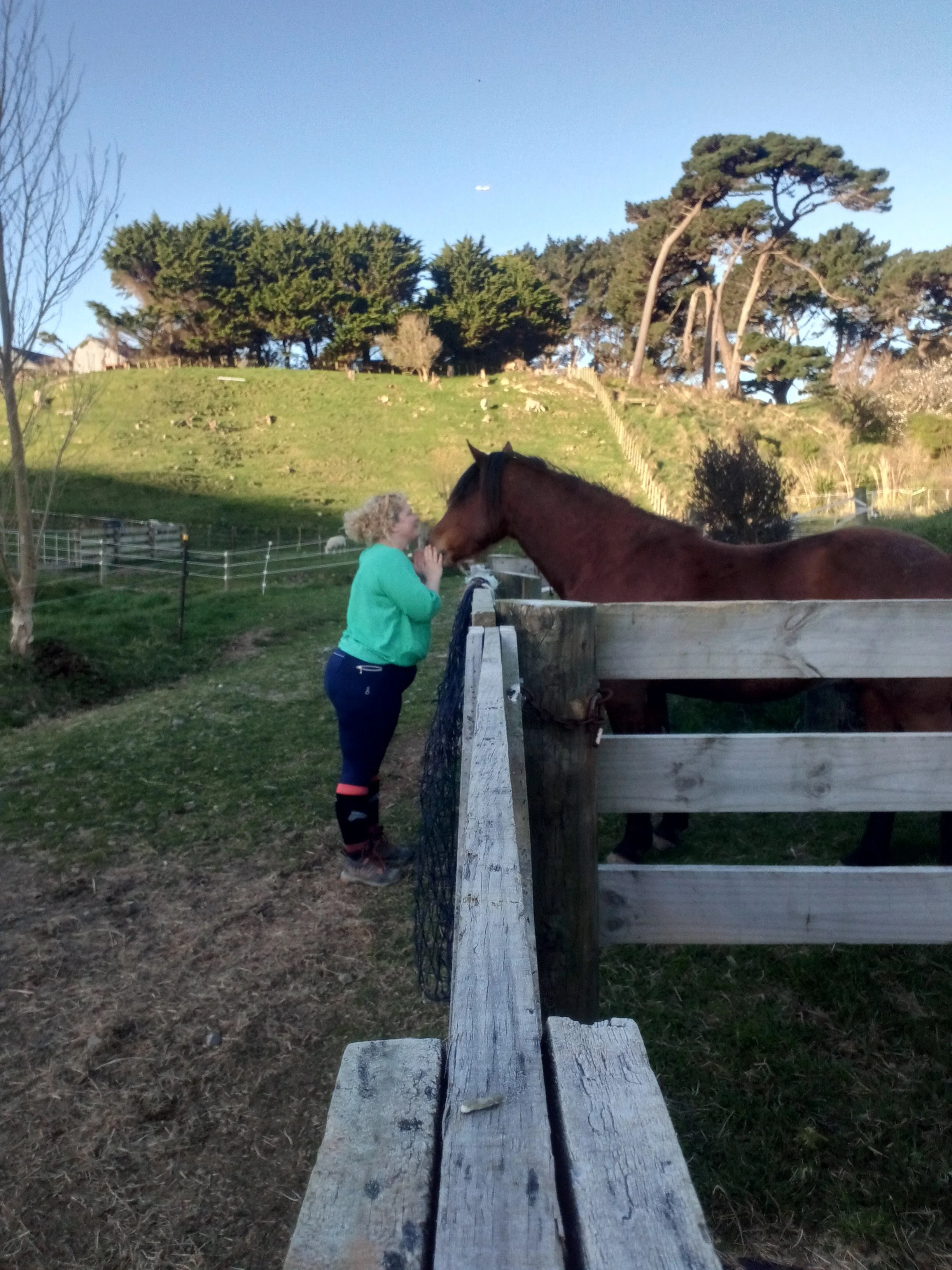
A woman with pink curly hair and a black jacket is touching noses with a dark brown horse with a white halter in a green, hilly outdoor landscape.

Your Investment

In my experience working with hundreds of horses, real change takes time. That's why I offer two ways to work together.

Assessment & Report — NZ$800 A 90-minute deep dive into your horse's history, environment, management, and behaviour. You'll leave with a full written report and a clear plan. For those who want the answers and are confident implementing independently.

Full Program — NZ$2,399 (assessment included) Everything in the assessment, plus 3 months of implementation support, 12 follow-up sessions, 3 confidence coaching sessions & unlimited WhatsApp support. This is where the real transformation happens. Payment plan available

Most clients choose the full program. The assessment is included — and you get 3 months of support

Available in-person across the lower North Island, or online via video call. Travel fee not included in the pricing.

Ready to stop guessing?

 FAQs

  • It’s a deep-dive session (about 90 minutes) where we look at your horse’s history, environment, management, training, and behaviour. Then we create a clear, tailored plan to address it.

    It’s the start of the journey to help you and your horse feel confident in each other again.

  • This is not a “done for you” program, it’s a “done with you“ program.

    Horse behaviour is complex and you as the owner/rider are part of the equation. This is why I work with horses in their own environment, and with their own people.

    The goal of these sessions is not to just fix something, it’s to

    • give you the knowledge and skills to be able to trouble shoot when you need to

    • to learn to read your horse

    • and to become someone your horse can trust.

    That is something we do together.

  • Everything from bucking, bolting, rearing, and biting to float loading issues, separation anxiety, ground handling problems, and more. If your horse is showing signs of stress, resistance, or unpredictability, I can help.

  • Sometimes, but not always.

    Most riding coaches are trained to teach riding skills, not to assess complex behavioural issues. Problem behaviours often have deeper causes, like pain, fear, confusion, or environmental stress - and those require a different skillset.

    I hold a Master of Science in Equine Science and have worked at internationally recognised institutions such as dr. Andrew McLean’s Australian Equine Behaviour Centre, where I deepened my understanding of horse learning, welfare, and behaviour. I draw on evidence-based methods, not guesswork or tradition, to get to the root of what’s going on.

    I’m happy to work alongside your regular coach, however if your horse is showing unsafe or confusing behaviour, a specialist behaviour assesment is often the best next step.

  • I use science-based, horse-friendly methods grounded in equitation science and learning theory. This includes:

    • Positive reinforcement where appropriate

    • Clear, low-conflict communication

    • Understanding stress responses, not punishing them

    • Teaching both horses and humans with empathy and clarity

    My goal is always to support the horse’s welfare, reduce confusion or fear, and help you build a more trusting, functional relationship.

  • No, I don’t use natural horsemanship techniques.


    While I value trust and clear communication, I don’t use join-up, flag work, or rope pressure. These methods can trigger the flight response and rely on outdated dominance ideas.

    Instead, I use evidence-based training grounded in learning theory and equitation science, so your horse learns in ways that make real sense to them, without fear or confusion.

  • Yes, I use positive reinforcement, including food rewards and clicker-style markers, when it's the right fit for the horse and the situation.

    Positive reinforcement is a key part of science-based training. That said, not every horse responds best to food or marking alone. In some cases, negative reinforcement (like releasing light pressure) or combined reinforcement may be more effective, especially when used thoughtfully and ethically.

    My approach is flexible, evidence-based, and always tailored to the horse in front of me. The goal is low-stress, clear communication that supports learning and the horse’s emotional wellbeing.

  • Not formally, but I do strongly recommend ruling out pain or health issues before treating something as a behaviour problem.

    I will ask questions about your horse’s health history or will suggest a vet check if physical discomfort seems likely.

    In cases where I suspect chronic stress I may refer you to the vet for medical stress support.

  • Very occasionally I walk into a behaviour session when it is not really what I’d consider a behaviour “problem” but it’s more a lack of rider skill. If that happens I will immediately recommend changing to lessons. However these cases are quite rare.

    It’s usually the other way around where someone books a lesson when they have a behaviour problem.

    But generally behaviour issues take at least 3 months of consistent work to start seeing a steady improvement.

  • That depends on your horse, the behaviour, and how consistent you can be with the new plan. We often start seeing positive changes immediately, but significant change usually takes approximately 3 months.

  • Yes! I offer video-based consults for clients outside my travel area. You’ll send video clips of the behaviour, and we’ll meet via Google Meet to go through an assessment, discuss changes, and build a plan together.

    Alternatively we can organise a clinic in your area for initial assessment and learning after which we can proceed online.

  • You’ll receive:

    • A written management and/or training plan you can share with your vet and coach

    • Clear next steps

    I can’t guarantee success after the initial assessment as behaviour is complex and each horse and rider pair is unique. The assessment is to help identify pain points so you can start making positive change

  • The full program is pretty extensive and is enough for most horse/rider combinations to see significant change.

    However, in some more complex cases, or when you maybe feel completely out of your depth we certainly can add on some extra sessions.

    I don’t do all the work for you, as it’s always about you and your horse as a combination, but it sometimes does help to let me do some more initial work to help kick start things.

  • Yes, but only once your horse is ready.

    You’re welcome to move into riding or groundwork coaching after the behavioural issue has been addressed and your horse is safe to handle in a coaching setting.

    This transition can happen when:

    • Your horse no longer shows unsafe or extreme behaviour (e.g. bucking, bolting, rearing, biting)

    • You feel confident handling them during a lesson

    • The issue has been resolved or is being safely managed

    • I believe coaching is now appropriate and productive for both of you

    In 97% of cases this happens after the three month full program. But in some more complex cases, further behaviour support may be required.

    My priority is always safety - for you, your horse, and anyone involved in your sessions.

  • I can’t 100% guarantee success. Only because

    1. Horse behaviour and behaviour modification are complex, and

    2. success is entirely dependent on how invested you are in making a positive change.

    Success can only be reached if you actually stick to the plan, take in the learning, and don’t start skipping ahead. If you don’t have the patience or if you want a quick fix I am not the person for you.

    We go at the horse’s pace, always.