You've spent the money.
You've tried the advice.
Something still isn't right.

The Horse Behaviour Blueprint is a structured behaviour assessment and three-month implementation program for riders who need more than another opinion — they need someone to actually look at the whole picture.

Living with "we've tried everything" is exhausting

You know your horse well enough to know something is off. You've probably had moments — maybe a scary one — that you haven't fully talked about. You've worked through vets, physios, saddle fitters, coaches. Some things helped, briefly.

But here you are, still managing it. Still second-guessing. Somewhere in the back of your mind, the word "sell" has surfaced — and you hate that it has.

  • Money spent on professionals without a lasting result

  • Time lost to approaches that helped for a bit, then didn't

  • The quiet dread before each ride

  • Wondering whether you're the problem, or he is — and not being sure which answer is worse

This is for you if:

Something hasn't clicked

  • Cycling between "it's him" and "it's me"

  • Behaviour that advice hasn't resolved

  • Not in crisis — but tired of just managing

  • He's not dangerous, but he's not fully with you

Properly stuck

  • A scary moment that changed things

  • Spent money, still in the same place

  • Every professional has had a different answer

  • Selling has crossed your mind

Both are the right time. Earlier just means more options.

  • Fear response resolved · no sedation required

    "My horse Layla used to be sedated with paste when clipped, but her response got more dangerous each year — to the point where she would strike out with her front feet while sedated. I had not been able to clip Layla in over three years until I got Susan's help. Working with Layla over a few months to desensitise her to clipping, Layla is now at a stage where she is accepting of being clipped, her fear response is gone and can be fully clipped all over with no sedation required."

    Nicole

  • Tension resolved · easier to ride

    "Susan communicates in a simple and uncomplicated manner — in a way that the rider understands, to then communicate it to the horse in a way he understands too. As a result Pirate is relaxing more and gives me a much easier ride."

    Miriam

  • Confidence rebuilt after a fall

    "When I had a nasty fall Susan helped me regain my confidence. She was very mindful of my comfort levels and gradually rebuilt my confidence using techniques she has learnt in her mental coaching. Susan goes the extra mile for her clients."

    Jacqui

Not an assessment. A blueprint.


Phase 1

Most behaviour consultations tell you what your horse is doing. This tells you why — and gives you the understanding to work with that, not just manage it.

We build a complete picture of your horse: his history, his patterns, his experience of his world, and what he's been trying to communicate. That understanding is what makes the plan work. Without it, you're just following instructions.

The assessment

A pre-visit call (60 min via video-call) so Susan arrives already understanding your horse's world. Followed by a 90-minute in-person or video assessment — his history, his environment, his patterns, what he's been communicating. A written report (within 5 working days), shareable with your vet, physio, or coach. A follow-up call two weeks later once you've had time to read it and start implementing.


Phase 2

Three months of implementation support

Full program only. Twelve weekly 45-minute sessions to put the plan into action — troubleshoot what comes up, build your ability to read your horse as things shift. Plus three confidence coaching sessions and direct WhatsApp/phone access between sessions. Because things don't only happen during appointments.


This isn't an assessment of your riding. It's a read of your horse — his history, his patterns, his world. You're part of that picture, but this isn't about finding fault.

Your investment


Most client choose this

The Horse Behaviour Blueprint — full program

NZ$3000

Everything. The assessment, the written report, and three months of weekly implementation support. The assessment is included — you're not paying extra for the starting point.

NZ clients: + GST. International clients: no GST.

Assessment & report only

NZ$1000

The pre-visit call, the 90-minute assessment, the full written report, and a 60-minute follow-up call two weeks later. For the rider who wants the answers and is confident implementing independently.

NZ clients: + GST. International clients: no GST.

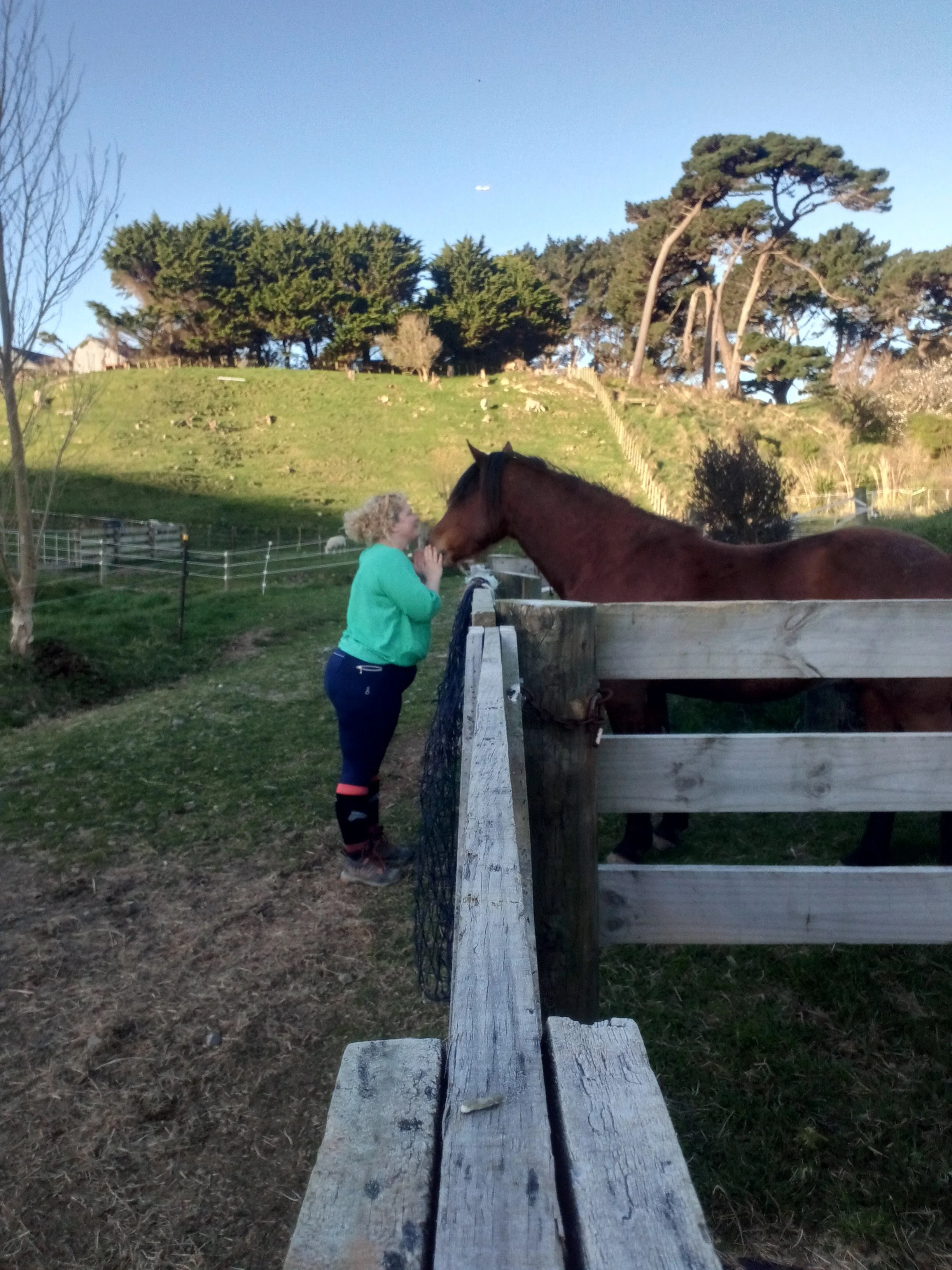
A woman with pink curly hair and a black jacket is touching noses with a dark brown horse with a white halter in a green, hilly outdoor landscape.

Who you're working with

Susan Nienaber

MSc Equine Science · BSc Environmental Science · ICF PCC · BHSAI

I've spent my career working with horses that other people found difficult — including specialist OTTB retraining in Hong Kong, where sensitive and reactive horses were the norm. I trained at the Australian Equine Behaviour Centre under Dr Andrew McLean, and my MSc in equine science and my BSc in Environmental Science both inform how I look at management, because behaviour doesn't happen in isolation.

I'm not working from a single method. I'm reading your horse — his history, his patterns, his world — and building something specific to him.

Based in Wellington, NZ. Available in-person across the lower North Island, or online via video call. Travel fees apply outside Wellington.

Ready to stop guessing?

Book a discovery call. We'll make sure this is the right fit — for you, for your horse, and for where you are right now. If this isn't where you are yet, that's okay. But if it is, let's talk.

 FAQs

  • It's a conversation, not a pitch. You tell me what's going on with your horse, I get a sense of the picture, and I'll likely already share some initial thoughts. It's also where I'm honest about whether I think I can actually help — if I'm not the right fit, I'll tell you that. You're also figuring out whether working with me feels right. No pressure, no obligation.

  • The clients I work best with are those who are willing to sit with a process — the real shifts usually happen once we're a few weeks in. If you're looking for a quick fix or a single-session solution, I'm probably not the right person, and I'd rather tell you that upfront than take your money. If you're not sure, the discovery call is the right place to start.

  • That's what the Assessment & Report is for. It gives you a complete picture of what's driving the behaviour and a prioritised plan — written up so you can take it to your own coach, trainer, vet, or physio. For some people, that's enough. What it won't do on its own is create behaviour change — that happens through implementation over time. You'll know what to do; the full program is where we work through doing it together.

  • I work from equitation science — which isn't a single method so much as a rigorous framework: the appropriate application of learning theory, horse biomechanics, and management principles. In practice, that means I'm not wedded to one approach or one tradition. I read your horse and draw on whatever behaviour modification tools are the right fit for him. The plan is built around who he is, not around what I usually do.

  • Generally, no. Once we've begun, you're paying for my time, knowledge, and the work we do together. That said, if something significant comes up — for example, if the assessment flags a health issue that requires veterinary attention before we can continue, and that issue turns out to be serious enough to change everything — we'll work out something fair. The honest answer is that I'd rather have that conversation directly than write a policy that tries to cover every scenario. If you have specific concerns, raise them on the discovery call.

  • Pain is something I expect clients to have investigated before we begin — it usually comes up during the discovery call and again on the pre-visit call, so we're not arriving to a horse with an unaddressed issue. If something does come up on the day of the assessment that wasn't flagged, we'll need to address that before we can continue meaningfully. I also don't assess in heavy rain or significant wind — I want to see your horse in his normal environment, not at his worst. If we need to reschedule for any reason, I'll always do my best to find something that works.

  • In-person is ideal for the initial assessment — it lets me pick up on small details that are harder to catch on a screen. That said, I work online regularly and it's genuinely effective, particularly when clients use something like a Pivo to give me a proper view. If you're outside the lower North Island, online is the practical option, and plenty of clients work with me entirely that way. There's also the option of organising a clinic if there are a few of you in an area — that can make an in-person visit viable. If you're unsure what would work best for your situation, we can sort that out on the discovery call.

  • We have a weekly session together, and in between you'll have homework to practise with your horse — usually two or three short sessions, depending on what we're working on. I'm not asking you to drill or overwork him. Sometimes that looks like daily short sessions; sometimes it's fewer but longer sessions with rest days built in for processing. I'll always tell you what I'm recommending and why, and we adapt as things shift.

  • Cancellations require at least 48 hours notice. If something comes up inside that window — your horse pulls up lame that morning, the weather looks genuinely bad — get in touch and we'll work it out. Horses are unpredictable and I'm not unreasonable.

    What I do ask is that you treat your sessions as the commitment they are. A late cancellation because something slipped your mind isn't something I'm able to accommodate — that session is forfeited.

    For in-person sessions: Wellington weather is forecastable. If you're watching the forecast and Saturday looks questionable, message me before the 48-hour mark and we can keep an eye on it together and make a call the morning of. I won't work in genuinely unsafe or unproductive conditions — but that call is made together, not unilaterally on the day.

    The full program runs for 12 sessions or three months, whichever comes first. Rescheduled sessions don't extend that window, so it's worth keeping that in mind if sessions start moving around.

  • Possibly yes — but it needs to be on the table from the start. If there's been a serious incident, or if the behaviour you're dealing with feels genuinely unsafe, please flag it on the discovery call or the pre-visit call. I don't want to arrive unprepared, and you don't want me to.

    For horses with more complex or high-risk behaviour, the standard program structure may not be the right fit as-is. In those cases, I'll put together a fully personalised proposal — that might mean more frequent sessions, collaboration with a veterinary behaviourist, or a different shape of support altogether. It won't be a one-size approach, and the investment may reflect that. The starting point is still the discovery call — we'll figure out from there what's actually needed.

  • That thought — wondering if selling is the only option — is one of the most common things clients come in carrying. You don't have to be hopeful or certain to book a discovery call. You just have to be willing to find out what's actually going on. Earlier means more options, but coming in when things feel stuck is still the right time. We'll figure out together whether this is the right next step.

  • No. This isn't an assessment of your riding, and it's not about finding fault. You're part of the picture — every horse is shaped by the relationship — but the focus is on understanding your horse: who he is, what he's been through, and what he's been trying to tell you.

    That said, it's worth being honest: this kind of work can be confronting. Most clients feel relief once they start seeing the full picture — but a lot of them also go through a period of harsh self-judgement, feeling like they should have spotted things sooner or done things differently. Those feelings are real, they come up often, and they can quietly get in the way of the process if they're not acknowledged.

    It's why the full program includes three dedicated mindset sessions. Not because this is about blame — it isn't — but because you deserve space to work through what comes up for you, not just what's going on with your horse. The clients who are willing to look at both sides tend to get the most out of this.